Index Copernicus: functioning, features and evaluation of journals
Today, the scientific community has access to a large number of international databases that provide indexing of scientific journals, conference materials, and other publications. These resources play an important role in popularising research and increasing its visibility. One such database is Index Copernicus, a platform that attracts the attention of many authors and publishers. We will consider its key features, operating principles, and journal evaluation criteria.
What is the Index Copernicus database?
Index Copernicus is an international scientometric database created in 1999 in Poland, which aims to index scientific journals and evaluate their quality. Its main goal is to support scientific communication, improve the visibility of scientific publications, and promote interaction between researchers.
The process of integrating scientific results into the socio-economic sphere begins with their structured description, i.e. parameterisation. In the Index Copernicus system, this process involves the creation of a standardised set of metadata that allows scientific achievements to be presented in a clear, unified format. This approach makes it possible to quantitatively evaluate scientific results by transforming descriptive characteristics into scores in accordance with a defined methodology.
The Index Copernicus databases record and parameterise information about scientific journals, research institutions, individual scientists and the results of their activities. For the analytical processing of this data, information and analytical tools are used that take into account so-called “evaluative events” – actions or events that are significant in the context of scientific activity as an element of the economy. During parameterisation, modern methodological approaches based on the principles of bibliometric and scientometric analysis are applied.
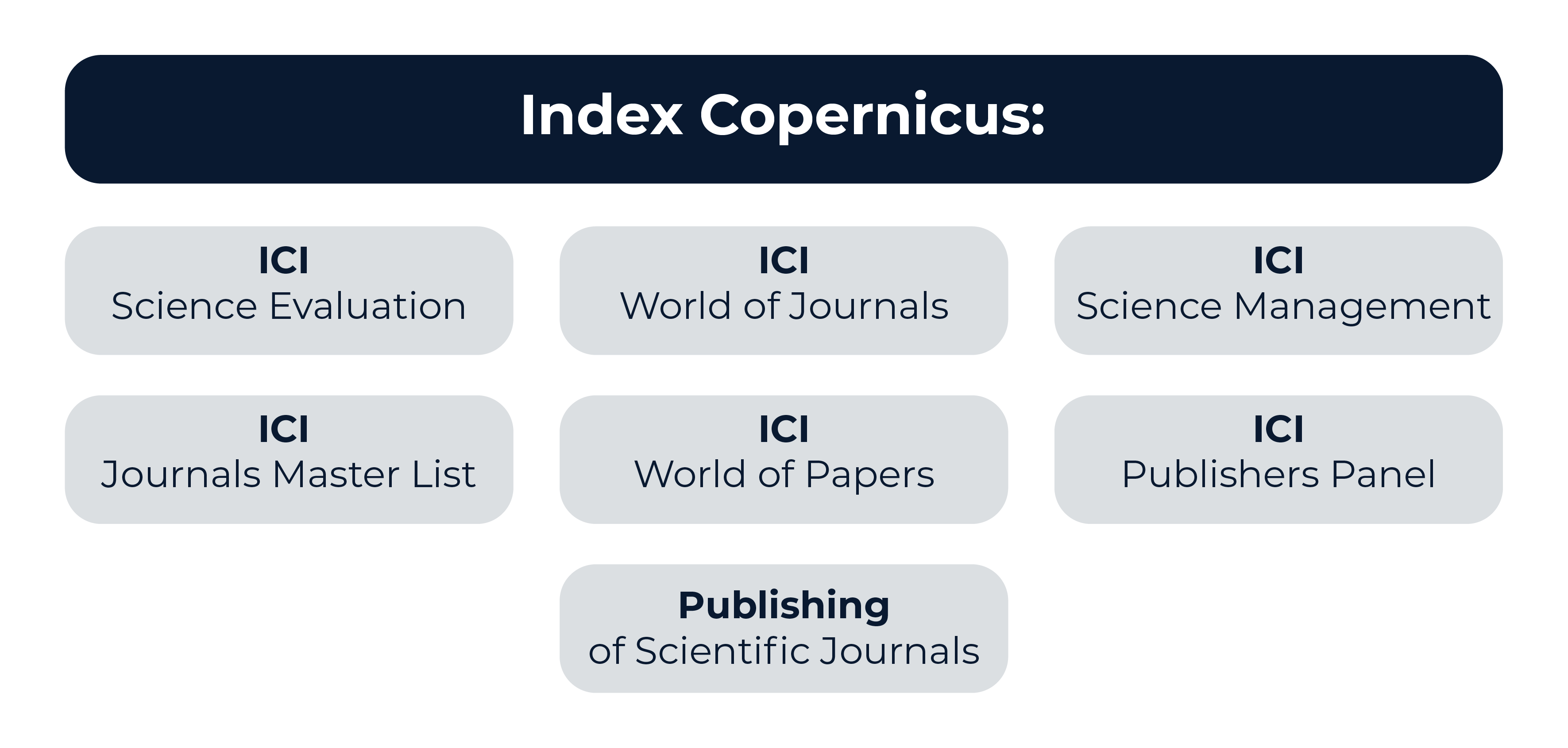
ICI Science Evaluation
ICI Science Evaluation is a system for the comprehensive evaluation of higher education scientific institutions based on their achievements in accordance with current legislation. It collects, processes and analyses relevant data, allowing for the regular evaluation of the scientific activities of institutions and individual employees.
Key features of the system:
- Automatic generation of reports, questionnaires and grant applications.
- Verification of the accuracy and completeness of information about scientific achievements.
- Calculation of points for achievements according to current journal lists and algorithms.
- Forecasting scientific categories for future evaluation of the institution.
- Monitoring the contribution of individual employees and identifying areas for improvement.
- Integration with external systems (POL-on, PBN, etc.).
- Prompt updates in line with changes in legislation and evaluation standards.
- Support from Index Copernicus experts with many years of experience.
The ICI Science Evaluation platform is provided in the form of software as a service (SaaS). Full implementation of the system takes 2 to 6 weeks, depending on the size of the scientific institution, with the ICI team taking primary responsibility for the launch.
ICI World of Journals
ICI World of Journals is an international database covering scientific journals from around the world. It provides editorial offices with free access to an IT platform where they can create a Journal Passport – a modern online showcase for their publication. The Passport contains information about the editorial board, publisher, journal website, as well as metadata and full texts of articles in PDF format.
The main idea behind the database is to ensure transparency in editorial practices and help scientific publications confirm their quality. Journals that do not meet transparency requirements receive warning labels:
- “Transparency Warning”
- “Predatory Warning”
The ICI World of Journals search engine allows you to:
- search for journals included in the ICI Master List with an ICV (Index Copernicus Value) rating
- check the ratings of journals by the Ministry of Science and Higher Education (MSHE rating)
- combine this data to select the most suitable publications for publication
Thus, ICI World of Journals is a convenient tool for scientists and editorial offices seeking to work transparently and effectively in the scientific space.
ICI Journals Master List
ICI Journal Master List is an international indexing database that has been indexing and evaluating scientific journals based on over 100 criteria for nearly 20 years. To be included in the database, publications undergo a multidimensional free evaluation, which involves confirmation of transparent editorial practices.
Key features of the system:
- Journals that meet the requirements receive an ICV – a quality indicator that is valid for one year.
- The ICI Publishing Stars model measures the development of publications in terms of publication stability, ethical standards, digitisation and internationalisation.
- The indexing process takes place annually with the ICV being updated based on the results of the previous year.
- Journal registration and evaluation are free of charge, and applications are submitted by completing a questionnaire within the established deadlines.
- If you are late, you can apply for indexing through an additional procedure – evaluation upon request.
- Journals that submit false information are not eligible for indexing in the current year.
The journal profile is managed by the Journal Representative – an employee of the editorial office or publisher who has the right to:
- receive notifications from Index Copernicus
- update information about the journal
- add scientific articles
- submit applications for indexing
ICI World of Papers
ICI World of Papers is a modern database of scientific articles with over 2 million publications. It provides a wide range of tools for convenient search of scientific materials.
The main features of the platform:
- Filtering by author, keywords, scientific field or specific journal.
- Regular content updates thanks to the editorial boards of journals registered with ICI World of Journals.
- Intuitive interface that facilitates access to up-to-date information.
Thus, ICI World of Papers is an effective tool for quickly searching and analysing scientific publications.
ICI Publishers Panel
ICI Publishers Panel is a modern online platform for managing the editorial process of scientific journals that does not require additional software installation. The system complies with international standards and helps increase the reach and citation of publications.
Key features of ICI Publishers Panel:
- Complete management of the editorial process via an electronic interface.
- Submission of manuscripts by authors online via a convenient form.
- Reviewing using flexible questionnaires.
- Creation of an easy-to-edit journal website with online version support.
- Maintenance of an archive of issues and article content in HTML format.
- Automatic generation of DOIs with integration into the CrossRef system.
- Monitoring of user activity, viewing of abstracts and full texts of articles.
- Publication of articles in Ahead of print mode.
- Selling individual articles or subscriptions, as well as collecting editorial fees through DotPay.
- Collecting contacts of interested readers through newsletter subscriptions.
- Distributing metadata to external databases (PubMed, CrossRef, POL-index, etc.).
Using the panel allows editors to:
- improve the distribution of scientific content
- implement international standards for publication in electronic and printed formats
- improve the journal's ranking in higher education
- increase citation rates at both the national and international levels
Publishing of Scientific Journals
Index Copernicus provides a wide range of publishing services tailored to the needs of editorial teams from various fields. A multilingual publication process (in Polish, English and other languages) and the commercialisation of scientific achievements with the involvement of advertisers are provided.
Main areas of work:
- Development of comprehensive publication strategies to increase citations and ratings, in particular in MNiSW and JCR.
- Full support of the publication process in accordance with international standards with a focus on the quality of scientific articles.
- Increasing the visibility of journals in international databases and repositories.
- Supporting the financial independence of journals through effective business models.
Additional benefits:
- analysis of indicators to support positions in rankings and MNiSW parameterisation
- access to a database of over 300,000 scientists to search for authors and reviewers
- international cooperation through the IC Journals Master List with over 70,000 journals
Partners include publications with impact factors, such as the Polish Journal of Otolaryngology, the Polish Journal of Surgery, and Bioalgorithms and Medical Systems.
Sustainable development of partners is supported with the aim of improving the quality and recognition of scientific journals.
ICI Science Management
Index Copernicus experts have developed the concept of scientific resource planning (SRP) – an effective tool for managing the resources of scientific organisations. On this basis, an innovative new-generation information and communication system has been created to support scientific research.
The main functions of the system are:
- Centralised management of research departments and accumulation of knowledge for effective leadership.
- Support for the formation of a scientific strategy similar to enterprise resource planning.
- Restoring the link between individual achievements and their impact on further scientific results.
- Cascading strategic goals at the level of the organisation, departments and individual project teams.
- Defining tasks for project participants, taking into account strategic priorities.
- Recording key indicators and analysing their compliance with defined goals.
- Systematic measurement of progress, identification of deviations and formulation of corrective measures.
The system is based on the concept of a balanced scorecard and is aimed at managing the creation of scientific achievements in research departments.
Index Copernicus Value
The ICV indicator is formed as the sum of points for 41 evaluation criteria, grouped into two main components:
- journal quality – includes assessment of standards, stability, digitisation and internationalisation
- journal impact – awarded only to journals indexed in Web of Science and/or Scopus, based on citation criteria and citation dynamics
The scoring algorithm was developed by Index Copernicus analysts
Based on the results of the evaluation, in addition to the ICV parametric index, journals are provided with a detailed evaluation report reflecting their compliance with the criteria.
The ICV is a parametric indicator based on data submitted by editorial offices in special surveys, as well as information collected on the Index Copernicus platform. Determining the citation index of journals is not within the competence of Index Copernicus.
The significance of Index Copernicus for authors of scientific works
Index Copernicus is a useful tool for authors at various stages of their scientific activity. It helps them navigate the early stages of their careers, monitor scientific journals at the national level, and verify basic information about publications. Thanks to this, the system contributes to the quality selection of journals for publication and supports the development of scientific activity in general.
Index Copernicus is a convenient platform for evaluating and promoting scientific journals, especially in the early stages of their formation and development. It contributes to the transparency of publishing processes, helps editorial offices comply with international standards, and creates opportunities to present research results to a wide audience.
The reputation of Index Copernicus
Scientists' attitudes towards the Index Copernicus database vary: some evaluate it positively, while others express critical comments. After surveying thousands of scientists and analysing statistics showing that the platform is visited by dozens of users from over 140 countries around the world, it can be concluded that Index Copernicus is an effective aggregator of scientific literature. It occupies one of the leading positions in the national scientometric space. Publishing articles in journals indexed by this database opens up additional opportunities for scientists to disseminate their research results, which is particularly important at the beginning of their careers.
For many scientists, especially those from Central and Eastern Europe, Index Copernicus has become a launching pad for entering the international arena. Thanks to a simple registration and evaluation procedure, the platform supports the development of young scientific journals, stimulates the improvement of their quality, and provides open access to key information about publications.
 Join
Join