DOAJ – a useful resource or a form of academic predation?
DOAJ is known in the scientific world as an international system that indexes journals from different countries. However, despite its authority, scientists are increasingly questioning the transparency of this platform and its actual reliability. In today's article, we will look at the problems of indexing, as well as the quality of journals and articles that make it into DOAJ.
DOAJ: General characteristics
DOAJ (Directory of Open Access Journals) is an international directory of open access journals, founded in 2003 in the United Kingdom. Its main task is to support the dissemination of scientific knowledge by indexing high-quality Open Access journals and ensuring their availability to the international scientific community.
As of September 2025, the DOAJ catalogue lists more than 22,000 journals from 139 countries, published in 89 languages.
Criteria for inclusion of scientific journals in DOAJ
When DOAJ was founded in 2003, peer review was one of the four main criteria for journal selection. In 2014, changes were made: the number of requirements increased to over 40, and most of them began to relate to the transparency of publishing processes and business ethics.
Peer review continues to be considered the main indicator of the quality of publications applying for indexing. DOAJ requires that articles be reviewed by at least two independent reviewers.
At the same time, the organisation emphasises: “Proper editorial policy, a high-quality editorial board, and good publishing practices are no less important indicators, as they are easier to verify than the peer review process”.
DOAJ funding – is everything so transparent?
Many questions arise regarding the funding of the international directory. Currently, the DOAJ official website lists seven organisations in the donor-sponsor section, including:
- Austrian Science Fund (FWF)
- Coalition S
- Netherlands Organisation for Scientific Research (NWO)
- French National Foundation for Open Science (FNSO)
- German Research Foundation (DFG)
- Norwegian Directorate for Higher Education and Qualifications (HK-dir)
- Spanish National Research Council (CSIC)
At the same time, DOAJ has a network of local representatives in various countries. This raises the logical question: where does the funding for their activities come from?
The organisation assures its openness and transparency, but the scientific community expects more detail – in particular, open financial reports and explanations of how resources are allocated. This could increase trust and strengthen DOAJ's reputation as a tool for the development of open science.
It is known that MDPI is one of DOAJ's official sponsors.
Predatory practices or double standards in DOAJ indexing?
DOAJ is increasingly demonstrating double standards in its treatment of its sponsors and the journals that are included in its directory. The most telling example is its relationship with MDPI (Multidisciplinary Digital Publishing Institute). This open access publisher is one of DOAJ's official sponsors, which calls into question the independence and transparency of decisions regarding the indexing of its journals.
Some scientists have repeatedly criticised MDPI for conflicts of interest and its commercial approach to science. Journals charge significant fees for each published article, which automatically creates a situation where rejecting an author is effectively equivalent to rejecting money. Authors are viewed as end users rather than participants in academic discourse or contributors to the advancement of knowledge.
This is confirmed by numerous testimonies. For example, Simen Andreas Adna Ellingsen, Associate Professor in the Department of Energy and Process Engineering at the Norwegian University of Science and Technology (NTNU), described his own experience of reviewing for MDPI:
I was given one week (!) to complete the review, whereas normally at least a month is allocated for this. It is clear that the journal is not interested in high-quality reports. I recommended a refund, but after two revisions, despite my objections, the article was simply published without comment. I did not communicate with any editors, only with a member of the editorial board.
Such examples show that peer review for MDPI is more of a formality than an academic procedure. Short deadlines, superficial changes and quick acceptance of articles all point to a focus on profit rather than quality.
Associate Professor Jonas Christiansen Noland and Professor Olav Bjarne Fosso from NTNU were reviewers and noted in their article in the University newspaper:
You are given a short time to read the article (ten days). After comments on significant revisions, a corrected version arrives the very next day, which is immediately scheduled for publication. Even when the reviewer insists on further changes or does not recommend the work for publication, experience shows that the article still appears in the journal as soon as possible.
In another publication, they calculated that in 2021 alone, MDPI printed about 40,000 special issues. This means a new issue every 15 minutes, 24/7, all year round. If every issue is “special”, is there anything special left at all? At the time of writing in September 2025, the maximum price for publication in MDPI journals is 2,700 Swiss francs, or just over 3,300 US dollars. As a result, “special issues” have become a mechanism for mass fundraising from scientists, who are forced to pay significant sums for publication.
In his article for Inside Higher Ed, owned by the world-renowned Times Higher Education (THE), Jack Grove noted:
In 2025, The International Journal of Molecular Sciences and Sustainability will publish 3,514 and 3,512 special issues, respectively, with a publication deadline of 2023, which is equivalent to more than 9 special issues per day.
Such practices call into question the scientific value of these publications. After all, when dozens or hundreds of special issues appear every year, it is difficult to talk about their uniqueness — it is more like a conveyor belt than academic selection.
And here the main question arises: why does DOAJ continue to index more than 400 MDPI journals, despite obvious critical signals from the academic community? The answer is simple: MDPI is one of DOAJ's key sponsors. Thus, DOAJ effectively indexes journals that, according to some scientists, engage in predatory practices, while receiving significant financial contributions from publishers. It seems that financial considerations prevail over quality criteria. Peer review is often outsourced to unqualified individuals on a commercial basis, reducing the process to a mere formality rather than a guarantee of scientific quality. At the same time, many independent journals that adhere to publication standards and policies are excluded from DOAJ without explanation and without the possibility of appeal. Some publishers have reported pressure and lack of feedback, but refrain from disclosing journal titles or ISSNs to avoid persecution.
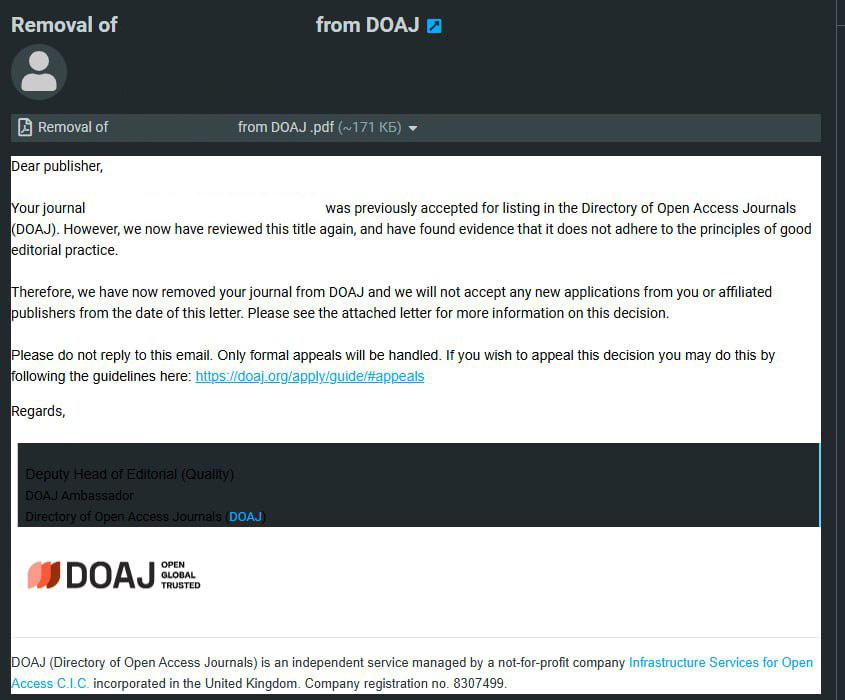
Thus, there is an obvious conflict of interest: DOAJ positions itself as a global tool for ensuring transparency and trust, but in fact becomes hostage to its financial sponsors. Journals that, according to some scientists, engage in questionable and openly predatory practices remain indexed in the directory. At the same time, other open access publications that comply with all standards but do not charge authors any publication fees are excluded without explanation. This undermines trust in DOAJ and calls into question the very idea of its authority in the scientific world.
DOAJ volunteers in 2025
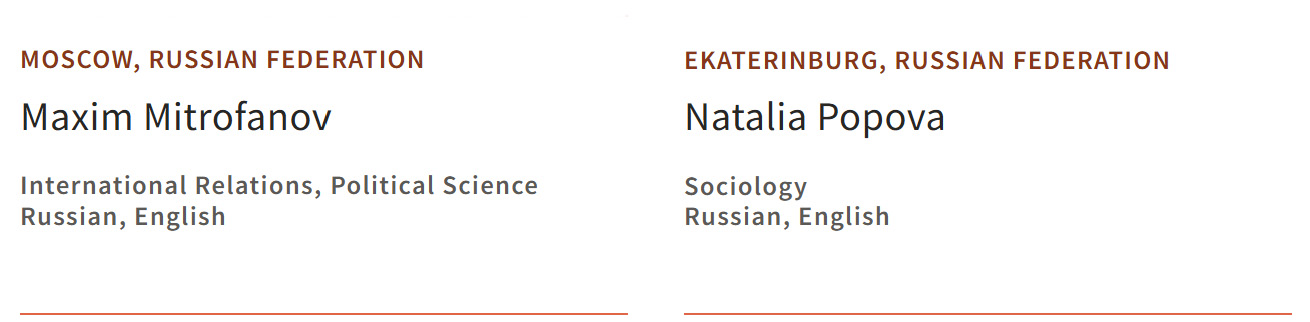
As of 2025, the DOAJ official website no longer contains information about funding from russian sponsors. At the same time, representatives of the aggressor country are still found in the list of platform volunteers.
Crimean scientific journals in DOAJ
In the spring of 2024, scientists discovered that DOAJ indexes journals registered in the temporarily occupied territories of Ukraine. In response, the Ministry of Education and Science of Ukraine initiated negotiations with DOAJ representatives to convey the official position of the state and demand the exclusion of such publications. In August 2024, it was officially announced that three Crimean journals would be removed from the catalogue.
| Physical Oceanography | The official publisher of this journal is the Marine Hydrophysical Institute of the National Academy of Sciences of Ukraine, but the materials were published by the Marine Hydrophysical Institute of the Russian Academy of Sciences without proper legal grounds. |
| Ecological Safety of Coastal and Shelf Zones of Sea | The journal of the Marine Hydrophysical Institute of the National Academy of Sciences of Ukraine, which was also illegally published by the Marine Hydrophysical Institute of the Russian Academy of Sciences. |
| Marine Biological Journal | Officially, the journal belongs to the A. O. Kovalevsky Institute of Biology of the Southern Seas of the National Academy of Sciences of Ukraine, but after the occupation, it was illegally published by the O. O. Kovalevsky Institute of Marine Biological Research of the Russian Academy of Sciences. |
This incident served as a wake-up call for scientists around the world: international indexes need stricter control and verification of the legitimacy of publications.
Can the quality of scientific journals and publications in DOAJ be trusted?
Despite the fact that there have been no direct repeats since last year's scandal with the indexing of Ukrainian journals under a Russian publisher, mistrust and concern remain among scientists. The DOAJ still lists the Crimean journal Krymskij Naučnyj Vestnik, founded by the Russian Federation after 2014 and published on the occupied peninsula. This directly contradicts the international recognition of Ukraine's territorial integrity under UN Resolution No. 68/262. This raises doubts about the DOAJ's position on the status of Ukrainian territory.
Since the start of the full-scale war in 2022, the platform has not changed its policy and continues to index Russian and Crimean publications that disseminate questionable scientific materials and pro-Russian narratives. This creates risks for the international scientific community and effectively serves as a propaganda tool.
Russian propaganda in scientific articles in DOAJ
| Scientific journal | Article title | Date of publication | Description |
| Ibero-American Notebooks | The Crisis in Ukraine and Russia’s Global Strategy | February 2023 | When analysing the conflict in Ukraine, two axes of confrontation are usually identified: russia versus Ukraine and russia versus the West. The author believes that this dichotomy is flawed. Ukraine acts as a kind of “battering ram” through which the West is trying to eliminate russia as an adversary and, subsequently, to challenge China. At the same time, the West is weakening and losing its global position, so the war in Ukraine is its last chance to simultaneously resolve key political and military issues and avoid direct conflict. |
| Management Consulting | Prerequisites, International Context and Features of NATO’s Proxy War against Russia in Ukraine (2022–2023) | August 2023 | The purpose of this article is to examine the preconditions and international context of the conflict in Ukraine, which, within the framework of the “special military operation” has turned into a protracted proxy war between russia and NATO. russian sociologists reflect the official position of the russian federation, while Western experts form a more objective assessment. NATO, led by the United States, seeks russia's strategic defeat through Ukraine by supplying modern weapons while trying to avoid direct conflict. The war is gradually moving beyond proxy relations and taking on a potentially global character. |
| East Asia: Facts and Analysis | The Ukraine Military Conflict is Testing the Strength of Russian-Chinese Relations | March 2024 | The relevance of this article is determined by changes in russian-Chinese relations caused by the military crisis in Ukraine and Western sanctions imposed on russia and China. The purpose of this study is to analyse the problems and prospects of cooperation between moscow and Beijing in the political, trade, economic and humanitarian spheres. In the context of the ongoing crisis in Ukraine, russian-Chinese relations are being tested for strength as they face comprehensive sanctions pressure from the “collective West”. Despite this pressure, relations between russia and China demonstrate growing political interaction in the international arena. In the trade and economic sphere, russia is trying to compensate for its weakness through Chinese investments and products, although for Beijing it is a less important partner than the EU or the US. To strengthen cooperation, both countries are working to intensify economic ties. Humanitarian cooperation is also an important part of this, aimed at countering Western ideology, developing mutual understanding and strengthening cooperation within the EAEU, SCO and BRICS.. |
| Problems of the Post-Soviet Territory | The Identity of Donbass in the Perception of Ukrainian Political Analysts (2014–2022) and the Construction of the Image of the Enemy | February 2025 | The relevance of the study lies in the strengthening of russian identity among Donbas residents in the context of the information war with Ukrainian nationalism. The aim of the work is to identify and critique myths about Donbas identity in Ukrainian political analysis (2014-2022). The main aspects of constructing the image of the enemy and using “hate speech” have been identified: russophobia, rejection of Orthodox and East Slavic self-identification common to russians and Ukrainians, falsification of historical facts, association of Donbas and its history exclusively with crime, marginality, and separatism. To strengthen russian identity politics in Donbas, it is necessary to shape the worldview of the region's inhabitants based on a positive perception of russian history and the traditional values of russian civilisation, as well as the skilled and timely debunking of the myths of Ukrainian nationalist propaganda. The authors propose the creation of an expert-analytical organisation in southern russia to study Ukrainian history and socio-political processes. |
Of course, this is not a complete list of materials published in russian journals available in DOAJ on similar topics. However, the examples given clearly demonstrate what kind of “scientific” content can be found in this popular directory, which declares its mission to be improving the quality, accessibility and impact of peer-reviewed publications. A logical question arises: if such texts are indexed in DOAJ, what kind of quality of scientific content can we talk about?
Promotion of DOAJ in Ukrainian legislation
Recently, there has been active discussion of amendments to the rules for compiling the list of scientific professional publications in Ukraine. In particular, the Ministry of Education and Science of Ukraine plans to establish a requirement in the new Procedure for the inclusion of journals in DOAJ, using indexing in this directory as a benchmark for the quality of scientific publications. Representatives of the Ministry of Education and Science of Ukraine present this as a conscious policy of the agency.
However, given the questionable practices of including and excluding journals, the presence of russian representatives among DOAJ volunteers, the indexing of Ukrainian publications from temporarily occupied territories, as well as the presence of propaganda and russian narratives about the war that has been going on since 2014, a number of questions arise:
- What is the real “deliberate position” of government representatives?
- Why is the DOAJ system being actively promoted in Ukrainian legislation by interested parties?
- What is the motivation and benefit of such cooperation between the Ministry of Education and Science of Ukraine and DOAJ?
These questions remain open at this time, and there are no clear answers to them yet.
Lack of transparency and contradictions in DOAJ policy
Today, more and more scientists and editorial offices are drawing attention to the fact that DOAJ's activities do not appear to be as transparent as they used to be. DOAJ's policy is formally based on volunteer work and hidden methods, which creates significant inconsistencies in the selection and exclusion of scientific journals. Based on this, we can draw several key conclusions.
1. Indexing and exclusion of journals from DOAJ
There are cases when DOAJ excludes journals without sufficient evidence – sometimes an anonymous complaint is enough, without providing facts or explanations. Information about the “exclusion of a journal” is disseminated publicly, which looks more like a publicity stunt than a reasoned decision. At the same time, the platform includes journals from temporarily occupied territories, which also raises doubts about the transparency and objectivity of the selection process.
The lack of clear, published criteria and a standardised exclusion policy creates uncertainty for publishers and researchers. Even when a response is provided to a request for reasons for exclusion, it is often vague: for example, reference is made to policy violations, but no specific points or cases are specified. This undermines the trust of the scientific community and makes it difficult to understand the selection process.
2. Requests for removal from other databases
DOAJ's requirements for editorial offices are also controversial. The directory sends letters demanding the removal of indexing from a number of other databases and platforms that evaluate scientific journals and form rankings. These include, for example, the Asian Science Citation Index, Index Copernicus, EuroPub, and others. At the same time, the only exceptions are Scopus and Web of Science, which remain “acceptable”.
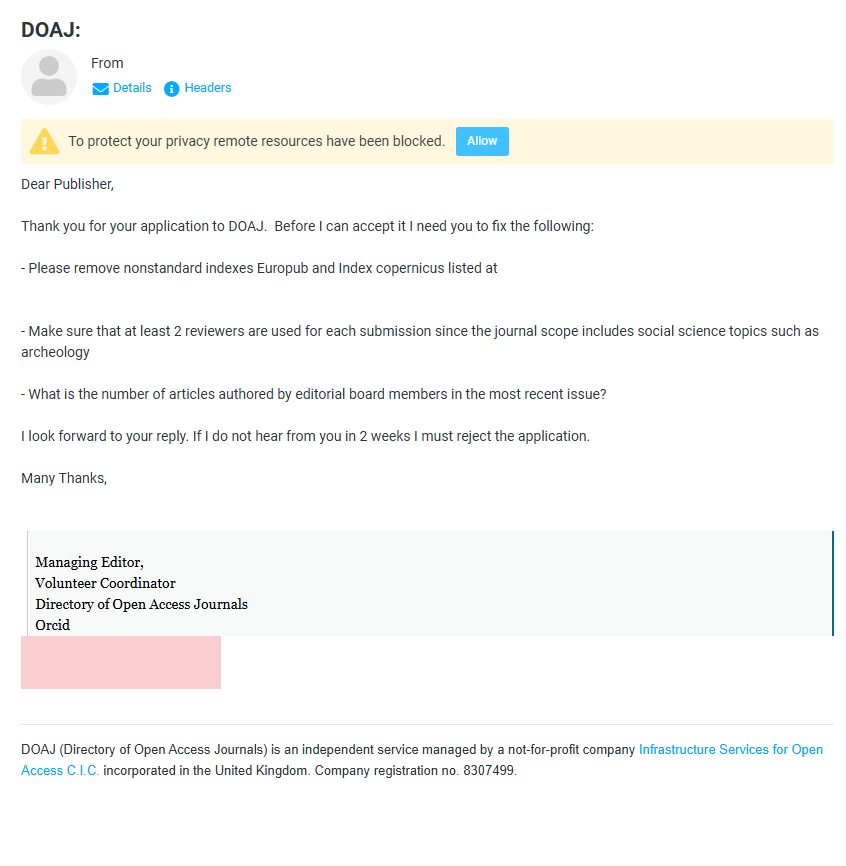
Representatives of Index Copernicus note that they still do not know what exactly DOAJ's claims against their activities are and what specific shortcomings they are accused of. This indicates a lack of transparent reasoning on the part of the directory.
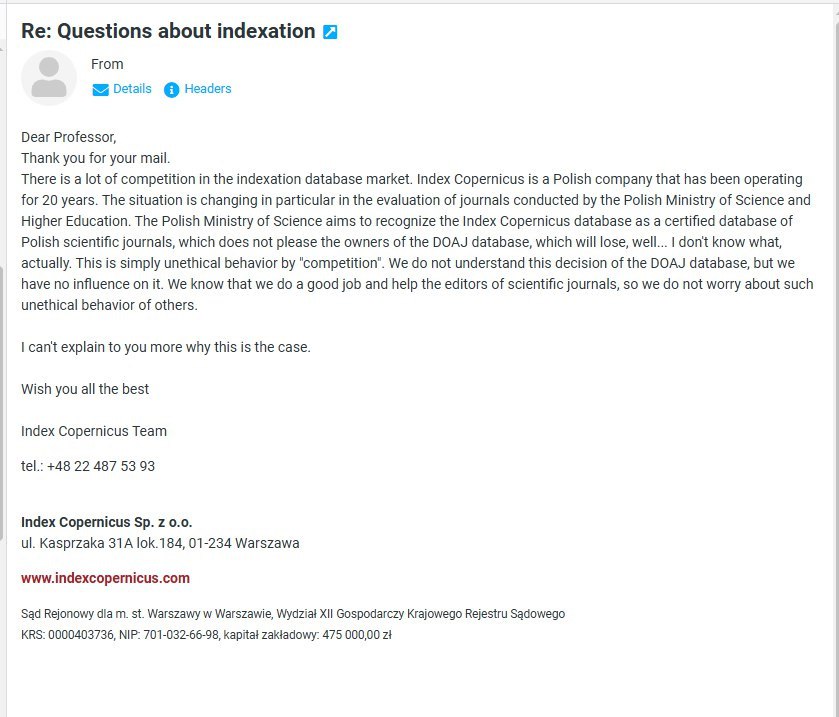
For part of the scientific community, this looks like an attempt to restrict competition and form a closed circle of “recognise” systems, creating a monopoly environment. This is especially true given that when submitting to Scopus, it is necessary to indicate whether the journal is indexed in DOAJ. This raises suspicions about the deliberate linking of systems and the increased dependence of editorial offices on DOAJ.
Index Copernicus, which DOAJ now requires to be removed, was a mandatory database for scientific journals in Ukraine just a few years ago. What was considered useful and necessary at the national level yesterday is now subject to severe blocking.
3. Selectivity and political influence
Concerns are increasingly being raised about the possible influence of non-scientific factors on the process of excluding journals from DOAJ. From time to time, it seems that scientific publications registered at universities or institutions that oppose state policy may be subject to unjustified removal. The same applies to journals from institutions where reform processes are planned. Such cases call into question not only the transparency of decision-making mechanisms, but also the very independence of the directory as an institution designed to guarantee quality and trust in the field of scientific publications.
4. Contrast between countries
In some countries, DOAJ demonstrates integrity and transparency, strictly adhering to standards for the inclusion and exclusion of journals. However, in the case of the Ukrainian division and a number of other countries, scientists have many questions that remain unanswered. This creates a situation where DOAJ is no longer perceived as a reliable tool for assessing the quality of scientific publications and is becoming more of a convenient tool for influence.
DOAJ was once considered a symbol of open science, but today its activities are often criticised for its opaque decisions and ambiguous approaches to indexing. The directory's policy, although positioned as a guarantee of quality, has serious gaps: vague standards, a lack of transparent exclusion rules, different approaches in different countries, and potential political influence.
The question of trust in materials indexed in DOAJ remains open. Despite its international authority, the catalogue includes journals of dubious quality or from territories whose status is not internationally recognised. Instead of being a reliable tool for assessing the quality of scientific publications, DOAJ risks becoming a platform for predatory practices and political influence. Every researcher should carefully check publications and treat DOAJ with caution.
 Join
Join
